 CYBERHORTUS
Cyberhortus // biography.log
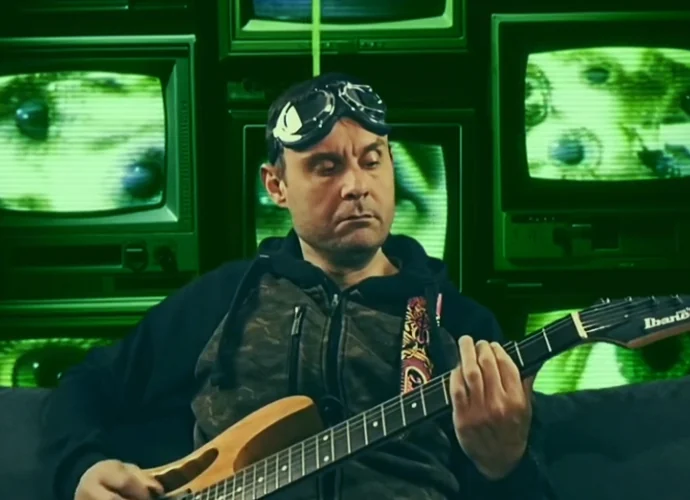
Dzianis Yafimau
Cyberhortus is the music project of Dzianis Yafimau, born out of a fairly long sequence of attempts, restarts, and configuration changes. To tell the story in software development terms, before its first stable release, the project went through several prototypes, a migration to another country, and roughly three years in a vocalist_not_found state.
It all started in Minsk.
Dzianis put his first band together with essentially one goal: to start playing. This was version 0.1: no grand concept, but the essential first experience. The next band was an attempt to raise both the technical level and the musical standards.
After a while, another problem emerged: endlessly playing covers was no longer interesting. He wanted to create original material.
So another band took shape, this time focused on original music.
Then came the biggest environment change: a move from Minsk to Gdańsk.
In a new country, the music project effectively had to be rebuilt from scratch. Dzianis knew almost no one, did not yet speak Polish, and found that looking for musicians was considerably harder than before.
At the same time, it gradually became clear that, technically, he no longer needed a full band all that much.
Guitars — he could record those himself.
Bass — that too.
Drums — those too.
Arrangement, sound, recording, editing, mixing — he could handle all of it on his own.
There was just one missing dependency:
female_vocal = null
Vocals became the main bottleneck. Many of the singers he found preferred cover bands or event performances, where music could start earning money straight away. A new original project with no audience and no released material was a much harder sell.
It was a classic deadlock: to find a singer, it helped to have finished releases; to finish the releases, he needed a singer.
About three years passed this way.
By then, Dzianis had moved to Gdynia and gradually turned his home into a fully equipped studio: a drum kit, guitar amps, several guitars, a bass, microphones, recording equipment, and everything needed to keep almost the entire music production process in one place.
Then the technology changed.
In spring 2025, Suno v4.5 arrived, bringing a noticeable improvement in the quality and expressiveness of synthesized vocals. For Cyberhortus, this was not a replacement for musicians, but a solution to a specific problem that had been blocking the entire project for years.
missing_dependency resolved
For the first time, artificial vocals sounded convincing enough to be treated as a production tool rather than a temporary placeholder.
At that point, Dzianis decided to stop waiting for ideal conditions.
He found a music distributor and set a hard deadline:
the first Cyberhortus track had to be released by the end of 2025.
By then, his drive was full of unfinished projects. Some songs had been around for years. One track had reached roughly 30 different versions — an excellent example of how endless iteration without a release date can become its own form of procrastination.
The deadline changed the workflow.
Instead of an endless:
idea → rewrite → rewrite → rewrite → someday
there was now a pipeline:
idea → arrangement → recording → edit → mix → master → release
On December 26, 2025, that pipeline completed successfully for the first time.
The debut single I Don't Know Who Turned on the Light was released — the first official Cyberhortus release.
Listen on Spotify
Three more songs followed. Together, they formed the project's first EP, Checklist: four tracks that finally turned years of unfinished DAW projects into a real discography.
unfinished_projects > released_music
Although songs from Checklist even received airplay on an independent Brazilian radio station, the EP has yet to reach a broad audience. In a sense, Cyberhortus still exists well below the noise floor of global recommendation algorithms.
But the release solved another, far more important problem.
Once there was real, published material, a human vocalist was found fairly quickly: Nadezhda Koshkina.
Together, they recorded the next Cyberhortus single, Artificial.
The result was almost ironic: a technology often accused of displacing musicians had, in Cyberhortus's case, actually helped find a human musician.
However, personal circumstances and other commitments have so far prevented them from continuing to record together regularly.
AI is a separate thread in the Cyberhortus story.
The project's name, visual language, lyrics, and overall aesthetic deliberately revolve around artificial intelligence, technology, machines, digital environments, and the relationship between people and the systems they create. As a result, the project is periodically labeled “AI music” and receives the backlash that comes with that label.
In practice, Cyberhortus is far less automated.
AI does not write Dzianis's guitar parts for him.
It does not record the bass.
It does not play the drums.
It does not build the arrangements.
It does not decide on a song's structure.
It does not make the final mix.
In the project's early stages, AI was used primarily as a vocal instrument, covering the one part of the music production stack that Dzianis could not perform himself.
In Artificial, the vocals are entirely human, recorded by Nadezhda Koshkina. AI was used only as a technical processing tool: to remove noise and room reflections, since the original vocal recording had been made in far from ideal acoustic conditions.
AI is also used as an assistant during mastering.
This fits the idea behind Cyberhortus well.
Dzianis came to music from the world of IT and sees technology as part of his toolkit, rather than something external or forbidden. When a technology offers a way to solve a problem, speed up a process, or try something that was previously impossible, it is worth opening up, taking apart, and testing.
new_tool detected → experiment()
At the same time, Cyberhortus's production process remains deeply personal. Dzianis takes the entire journey himself, from the first riff or idea through arranging, recording the instruments, and creating the final mix.
At some point, though, it became clear that knowing how to play instruments was not enough to actually release music.
He had to learn to record.
Then to edit.
Then to mix.
Then to understand sound.
Then to understand releases and distribution.
Then to work on the project's visual side.
And to keep learning.
So Cyberhortus is less a story about using AI in music than a story about trying to remove every reason why music does not get released.
No band? Record the instruments yourself.
No studio? Build your own.
No singer? Find a temporary technological solution.
No mixing experience? Learn.
A track exists in thirty versions? Set a deadline and release one.
while (track.isUnreleased) { finish(track); }
Today, Cyberhortus continues to work on several new songs and is still exploring its creative direction.
The style has not finished compiling.
The project's boundaries are deliberately left open.
The experiment continues.
The next album will reveal what the next version looks like.
Cyberhortus // human signal. mechanical noise.
status: running_